CONTRAIL
Delay KM-09
Echoes that follow the groove, from clean digital to worn tape.
AU · VST3 · macOS
What it does.
CONTRAIL has four modes. Digital is clean and exact. Tape glides when you change the time and adds wow, flutter and saturation. Analog follows a bucket-brigade line, so the repeats lose bandwidth as the delay gets longer. Diffuse smears every repeat through allpass filters until the echoes melt into a tail. Times run from 1 ms to 4 seconds.
Sync to the session in straight, dotted and triplet values, ping-pong across the stereo field, and let ducking keep the repeats out of the way until the singer breathes.
- Best on
- Vocal throws · Guitars · Synths · Transitions
- Line
- Precision
- Category
- Space
Hear it.
The same recording without and with CONTRAIL, set from SCAN and adjusted by ear. Switch while it plays; the position stays where it is.
The before-and-after examples are being recorded. They will appear here.
What's inside.
Four modes
Digital, Tape, Analog and Diffuse, each with its own behavior inside the feedback loop.
Tempo sync
Nineteen note values, from a 1/32 triplet to 2/1, straight, dotted and triplet, or free time from 1 ms to 4 s. Left and right can run different times.
Ping-pong and width
Bounce the repeats between the speakers, and open the stereo width to 150 %.
Filters and drive in the loop
A low cut from 20 Hz to 2 kHz and a high cut from 500 Hz to 20 kHz inside the feedback, so each repeat gets thinner or darker. Drive adds saturation.
Ducking and Freeze
Ducking keys from the input or the sidechain, so repeats wait for the gaps. Freeze holds the buffer so the loop keeps going for a build.
Tape and analog character
Wow, flutter and age in Tape. Companding and a chorus-style modulation in Analog. Time changes glide like a varispeed transport in Tape and crossfade cleanly in Digital.
SCAN for CONTRAIL.
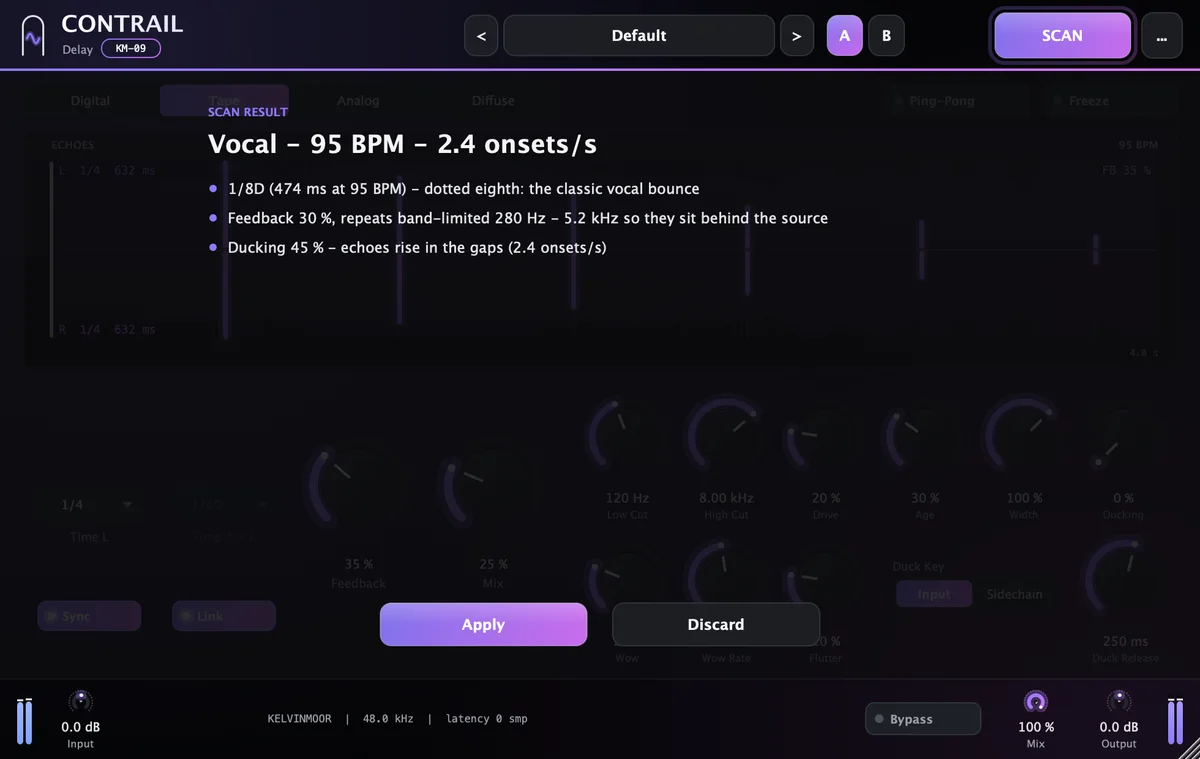
Play the part with the beat running for about ten seconds. SCAN measures the take and proposes settings for Mode, Note value, Feedback, Loop filters, Ducking, Mix. Each move comes with the reason, in one line.
Apply it with one click, then trust your ears. It is a starting point an engineer would be happy to begin from.
Play the part with the beat running for about ten seconds.
- Source
- Vocal
- Tempo
- 140 BPM
- Onsets
- 2.4 per second
- Sibilance
- +7 dB over the body
Recommended
- Dotted 1/8 (321 ms at 140 BPM): the classic vocal bounce
- Tape mode, feedback 30 %: the repeats are band-limited from 280 Hz to 5.2 kHz, so they sit behind the vocal
- Ducking 45 %: the echoes rise in the gaps
- Mix 18 %
Example readout. The values depend on your material.
Specifications.
Controls
- Modes
- Digital · Tape · Analog · Diffuse
- Time
- 1–4,000 ms · Tempo sync
- Note values
- Straight · Dotted · Triplet
- Feedback
- 0–110 %
- Loop filters
- Low cut 20–2,000 Hz · High cut 0.5–20 kHz
- Drive / Character
- 0–100 %
- Modulation
- Depth 0–100 % · Rate 0.05–10 Hz · Flutter 0–100 %
- Stereo
- Link L/R · Ping-pong · Width 0–150 %
- Ducking
- 0–100 % · Input or sidechain · Release 20–1,000 ms
- Freeze
- On · Off
Formats and system
- AU
- macOS
- VST3
- macOS
- AAX
- Coming soon
- Windows
- Coming soon
- macOS
- 11 Big Sur or later
- Processor
- Apple silicon and Intel
- Sample rates
- 44.1–192 kHz
- Channels
- Mono and stereo
- Interface size
- 75–200 %
- Latency
- Reported to the host
CONTRAIL
Delay. One payment, yours to keep.
List price $79−51%, now $39Launch price
- Free 7-day trial before you buy
- Serial for 1 computer at a time, works offline 45 days
- Free updates for version 1
Add another plugin and both are 15% off; ten or more, 45% off. How bundles work, or all twenty in Complete for $299.