FOUNDRY
Guitar KM-17
Cast your guitar tone.
AU · VST3 · macOS
What it does.
FOUNDRY takes a guitar from DI or mic’d to a finished part: a four-band dynamic EQ, a FET compressor, an amp and cabinet, a delay and a room. The amp has two triode-style gain stages in Clean, Crunch and Lead voicings, a bass, mid and treble stack, and three cabinets with a mic position.
SCAN listens to the part and sets the tone: a low cut, the compressor, a clean or crunch amp with a matching cabinet, a dotted-eighth delay and a chamber sized to the tempo. Switch the amp off when you are already recording a mic’d amp.
- Best on
- Electric guitar · DI guitar · Clean strums · Rhythm parts
- Modules
- EQ · Comp · Amp · Delay · Room
- Line
- Suites
- Category
- Suites
Hear it.
The same recording without and with FOUNDRY, set from SCAN and adjusted by ear. Switch while it plays; the position stays where it is.
The before-and-after examples are being recorded. They will appear here.
What's inside.
EQ
Four dynamic bands from the ISOTHERM engine to clear the low end and tame what rings.
FET compressor
The FLINT engine: 20 µs to 800 µs attack, four ratios plus ALL, Blue and Black revisions, and its own Mix for parallel sustain.
Amp
Clean, Crunch or Lead: two triode-style gain stages with inter-stage filtering, run at 4×, then a bass, mid and treble stack and a soft power stage.
Cabinet and mic
1x12 open, 2x12 closed or 4x12 vintage, or No Cab for a mic’d amp. Mic Position moves from the center of the cone, bright and close, to the edge, darker and rounder.
Delay and room
A delay with Digital, Tape, Analog and Diffuse modes, synced to the session, and a reverb that starts on the Room algorithm.
Switches and presets
Switch any stage off without clicks. Presets cover a clean strum, a dry rhythm part, and a mic’d guitar with the amp off.
SCAN for FOUNDRY.
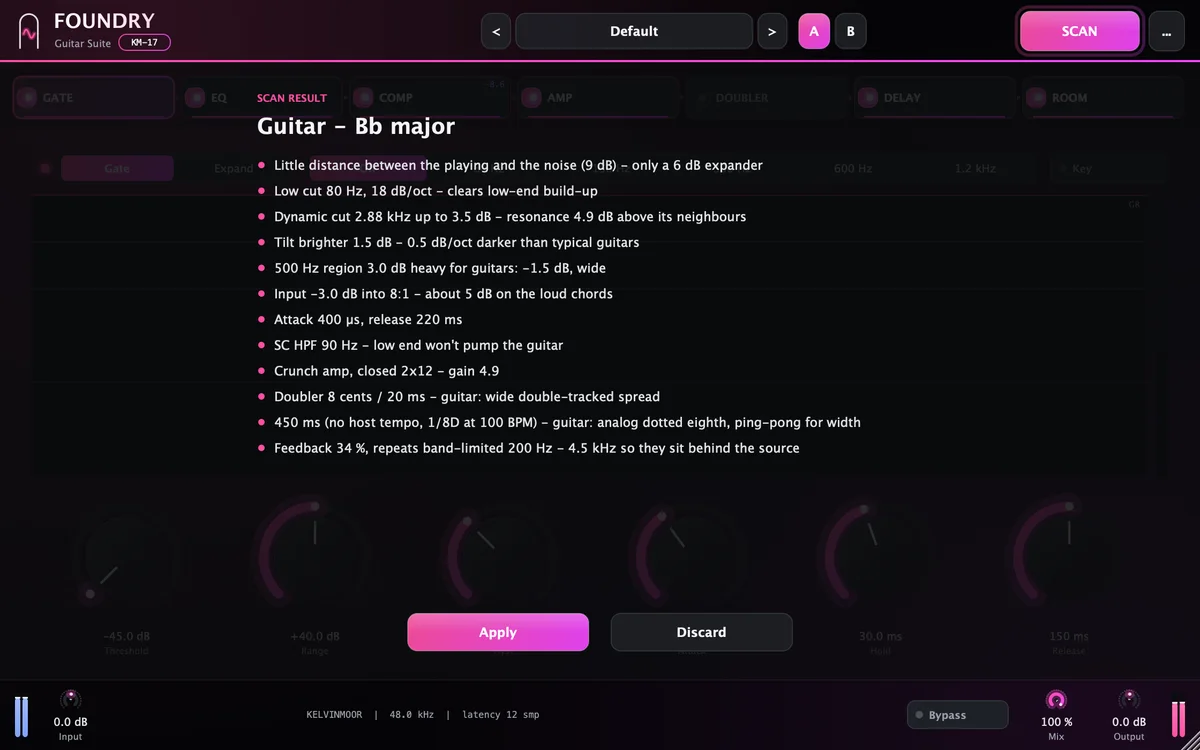
Play your guitar part for about ten seconds. SCAN measures the take and proposes settings for EQ, Comp, Amp, Cabinet, Delay, Room. Each move comes with the reason, in one line.
Apply it with one click, then trust your ears. It is a starting point an engineer would be happy to begin from.
Play your guitar part for about ten seconds.
- Source
- Guitar
- Peak
- −5.0 dBFS
- Crest factor
- 14.5 dB
- Tempo
- 120 BPM
Recommended
- EQ: low cut 92 Hz, 18 dB/oct, to clear low-end build-up
- Comp: 8:1 on the Blue revision, Input +1.5 dB, Output +4.5 dB, release 125 ms in time with 120 BPM
- Amp: Crunch, gain 5.5, closed 2x12, mic position 30 %
- Delay: Analog, dotted 1/8 (375 ms at 120 BPM), ping-pong, feedback 34 %
- Room: Chamber, 1.5 s decay, mix 20 %
Example readout. The values depend on your material.
Specifications.
Controls
- Modules
- EQ · Comp · Amp · Delay · Room
- EQ
- 4 dynamic bands · 9 shapes
- Comp
- Input −24 to +36 dB · 4 ratios + ALL · Blue · Black
- Amp voicing
- Clean · Crunch · Lead
- Gain / Bass / Mid / Treble
- 0–10
- Cabinet
- 1x12 Open · 2x12 Closed · 4x12 Vintage · No Cab
- Mic Position
- 0–100 %
- Amp Level
- −24 to +12 dB
- Delay
- Digital · Tape · Analog · Diffuse · 1–4,000 ms
- Room
- Hall · Plate · Room · Chamber · Ambient · Shimmer
Formats and system
- AU
- macOS
- VST3
- macOS
- AAX
- Coming soon
- Windows
- Coming soon
- macOS
- 11 Big Sur or later
- Processor
- Apple silicon and Intel
- Sample rates
- 44.1–192 kHz
- Channels
- Mono and stereo
- Interface size
- 75–200 %
- Latency
- Reported to the host
FOUNDRY
Guitar · Guitar Suite. One payment, yours to keep.
List price $99−51%, now $49Launch price
- Free 7-day trial before you buy
- Serial for 1 computer at a time, works offline 45 days
- Free updates for version 1
Add another plugin and both are 15% off; ten or more, 45% off. How bundles work, or all twenty in Complete for $299.