
FLINT
FET Comp KM-03
Field-effect speed and bite: from invisible peak control to all-buttons-in aggression.
AU · VST3 · macOS
What it does.
FLINT is a FET compressor. Attack runs from 20 microseconds to 0.8 milliseconds, release from 50 milliseconds to 1.1 seconds, and there are four ratios plus the all-buttons mode that turns it into an effect. Run it fast and light to catch peaks you never hear it catching, or push it until the drums breathe.
Two revisions with different harmonic character: Blue is faster and more colored, Black is cleaner. A sidechain high-pass keeps the low end from pumping, the sidechain input is there when you want to key it from another track, and Mix blends the aggression back in without a second track.
- Best on
- Rap and pop vocals · Drums · Bass · Parallel compression
- Line
- Heritage
- Category
- Dynamics
Hear it.
The same recording without and with FLINT, set from SCAN and adjusted by ear. Switch while it plays; the position stays where it is.
The before-and-after examples are being recorded. They will appear here.
What's inside.
20 µs to 800 µs attack
Fast enough to catch the front of a transient, slow enough to let it through. Release runs from 50 ms to 1.1 s and stretches when the reduction is sustained.
Four ratios and ALL
4:1, 8:1, 12:1 and 20:1, each with its own threshold and knee. ALL is the all-buttons mode: a very high ratio and an over-compressing curve where the output falls as the input rises.
Two revisions
Blue is faster, with more color. Black is cleaner, with lower distortion.
Sidechain filter and key
High-pass the detector at 60, 90, 150 or 250 Hz, or key it from the sidechain input.
Oversampled at 4×
Microsecond attacks alias at 1×. FLINT runs its gain stage and its class-A output at 4×.
Two meters, link and Mix
Switch the needle between gain reduction and output level, link or unlink the channels, and blend dry and compressed with Mix.
SCAN for FLINT.
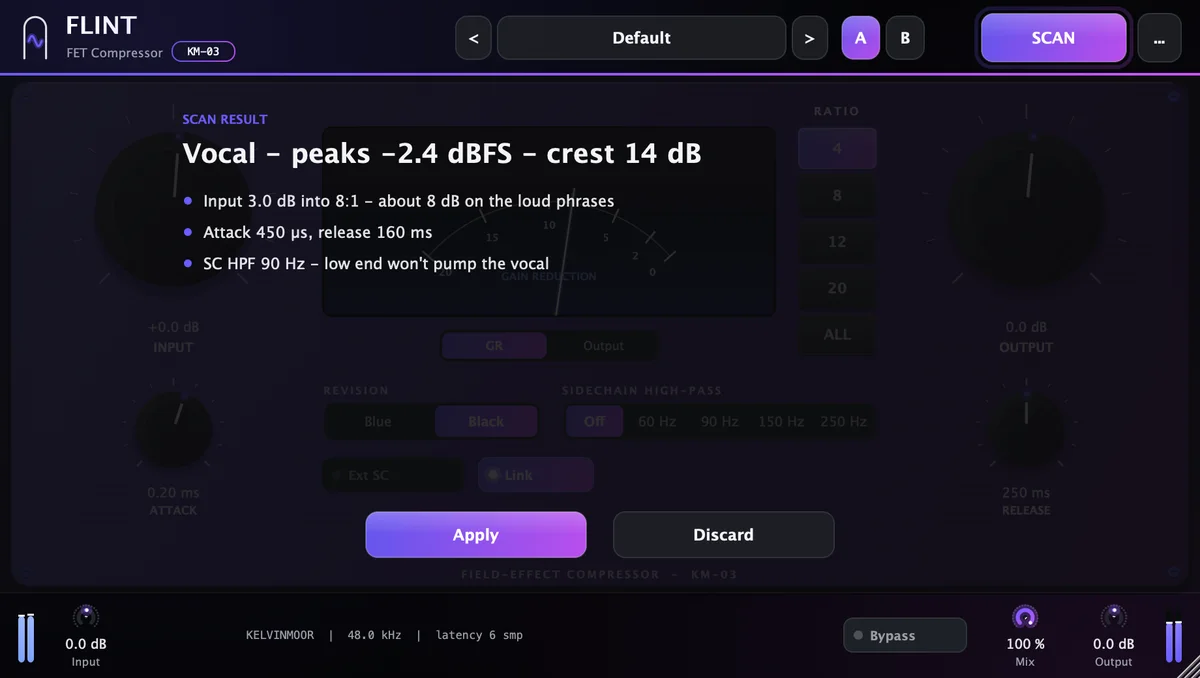
Play the loudest section for about ten seconds. SCAN measures the take and proposes settings for Input, Output, Ratio, Revision, Attack, Release, Sidechain HPF. Each move comes with the reason, in one line.
Apply it with one click, then trust your ears. It is a starting point an engineer would be happy to begin from.
Play the loudest section for about ten seconds.
- Source
- Vocal
- Peak
- −3.0 dBFS
- Crest factor
- 17.1 dB
- Tempo
- 92 BPM
Recommended
- Input +4.0 dB into 4:1: about 8 dB of reduction on the loud phrases
- Attack 450 µs, release 165 ms: recovers in time with 92 BPM
- Output +3.5 dB: makes up the loudness the compression takes
- Revision Black, sidechain HPF 90 Hz: cleaner on a vocal, and the low end will not pump it
Example readout. The values depend on your material.
Specifications.
Controls
- Input
- −24 to +36 dB
- Output
- −24 to +24 dB
- Attack
- 0.02–0.8 ms
- Release
- 50–1,100 ms
- Ratio
- 4:1 · 8:1 · 12:1 · 20:1 · ALL
- Revision
- Blue · Black
- Sidechain HPF
- Off · 60 · 90 · 150 · 250 Hz
- External sidechain
- On · Off
- Stereo link
- On · Off
- Mix
- 0–100 %
Formats and system
- AU
- macOS
- VST3
- macOS
- AAX
- Coming soon
- Windows
- Coming soon
- macOS
- 11 Big Sur or later
- Processor
- Apple silicon and Intel
- Sample rates
- 44.1–192 kHz
- Channels
- Mono and stereo
- Interface size
- 75–200 %
- Latency
- Reported to the host
FLINT
FET Comp · FET Compressor. One payment, yours to keep.
List price $79−51%, now $39Launch price
- Free 7-day trial before you buy
- Serial for 1 computer at a time, works offline 45 days
- Free updates for version 1
Add another plugin and both are 15% off; ten or more, 45% off. How bundles work, or all twenty in Complete for $299.


